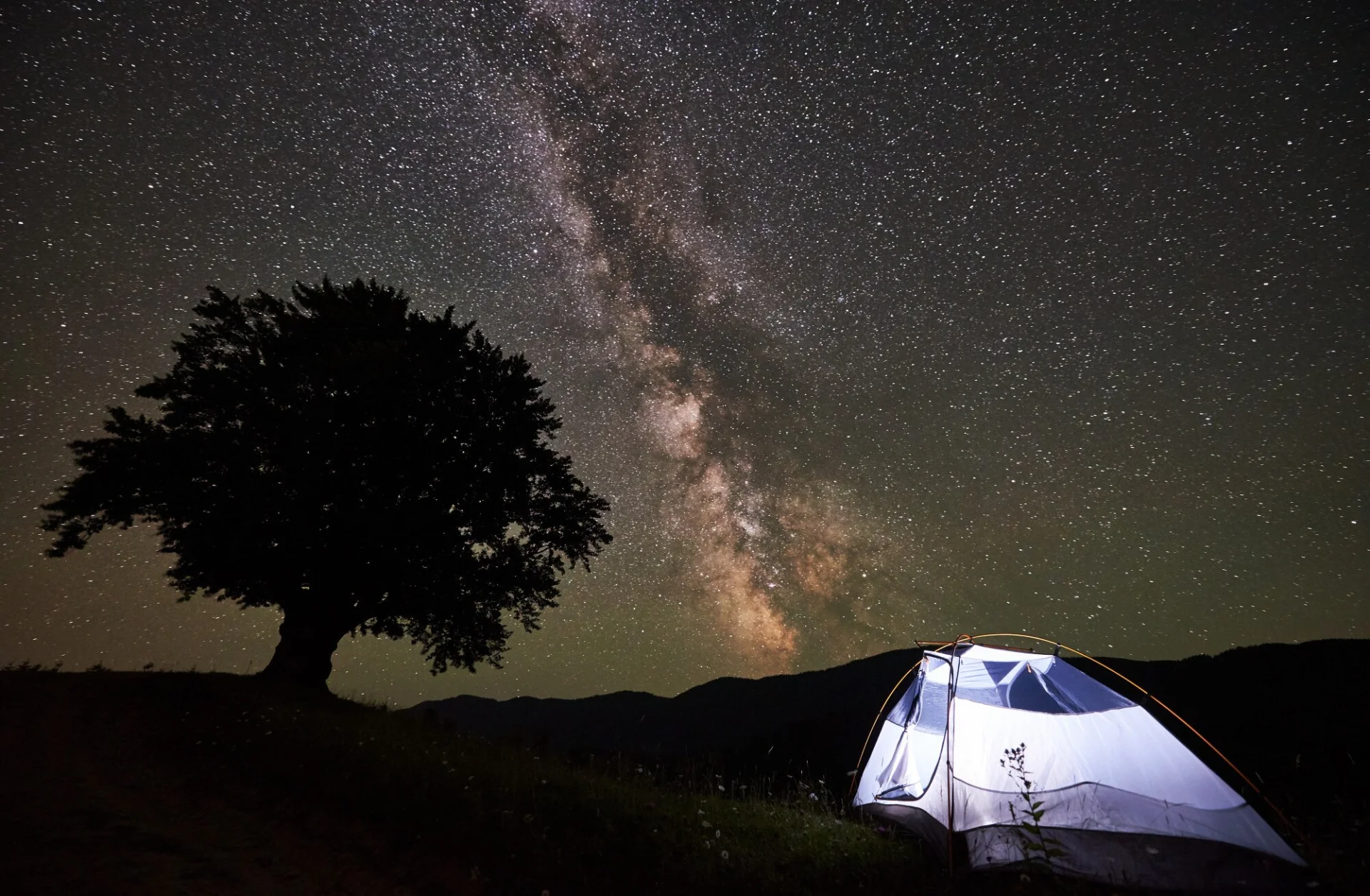
Under canvas, the night is never far away. Often all you need to do is move a few steps away from the street lights to discover the Milky Way, entire constellations and, with a bit of luck, a shooting star. Here's how to choose the right location, the right night and the right equipment.
Choosing a truly dark sky
Light pollution is the enemy of stargazing. The further you get from cities, the darker the sky becomes and the more stars become visible. In France, seven territories hold the label of International Dark Sky Reserve (RICE), awarded by the DarkSky International association to places that protect the quality of their night:
- Le Pic du Midi (Hautes-Pyrénées), France's first reserve, designated in 2013;
- Le parc national des Cévennes, presented as Europe's largest reserve;
- Alpes Azur Mercantour, in the hinterland near Nice;
- Le parc naturel régional de Millevaches en Limousin;
- Le parc naturel régional du Vercors;
- Le parc naturel régional des Landes de Gascogne;
- Le Morvan, the most recent, recognised in 2025.
There's no need to aim for a reserve: sparsely populated countryside or a mountain campsite already offer a far richer sky than the city. To find an isolated spot, the campsite map is handy.
A few campsites in the heart of these skies
- In the Pyrenees, camping La Ribière at Barèges, at the foot of the Tourmalet pass, is not far from Le Pic du Midi.
- In the Cévennes, camping Le Pont du Tarn at Florac is a good base for reaching the causses and Mont Lozère.
- In the Vercors, camping Les Myrtilles at La Chapelle-en-Vercors is located on the plateau.
- On the Millevaches plateau, camping Bois et Nature at Royère-de-Vassivière is close to Lac de Vassivière.
- In the Morvan, camping Les Mésanges at Montsauche-les-Settons, near Lac des Settons.
Before booking, check the campsite's night-time lighting: some turn off or dim the lights from a certain time onwards, others don't.
Choosing the right night
The Moon matters as much as the location. A full moon lights up the sky so much that it wipes out a large number of stars. Nights close to the new moon are the best: consult a lunar calendar before you leave.
Two events happen every year:
- The Perseids, in the middle of summer: the peak occurs around the night of 12 to 13 August. It's the most famous meteor shower, and the easiest to follow at a campsite thanks to mild nights.
- The Geminids, in December: the peak is expected during the night of 13 to 14 December. They're often abundant, but you have to brave the cold.
Outside these dates, autumn and winter have an advantage: nightfall comes early, so you can observe from early evening without staying up late.
Useful equipment
- Nothing at all, to start with: the naked eye is enough for the Milky Way and shooting stars.
- A red-light torch: it allows you to move around without losing your eye's adaptation to darkness. Alternatively, red paper over a headtorch works just as well.
- Binoculars: simple binoculars already show the Moon's craters and far more stars.
- An app or a star chart to identify constellations (remember to switch your screen to night mode).
- Something to lie on: a camping mat or a sun lounger, a sleeping bag or a blanket. Even in August, moisture and cool temperatures are felt after midnight.
Good practices on site
- Allow your eyes twenty minutes or more to adjust to the darkness, without looking at a bright screen.
- Move away from the facilities and lit paths, without leaving the campsite boundary at night if you're unfamiliar with the area.
- Respect the peace of the night: speak quietly and don't shine lights into neighbouring tents.
- Check the weather: a clear sky and no mist are essential. In the mountains, clouds can come quickly.
To find a quiet campsite, away from the lights, browse all our campsites by region. Sweet dreams under the stars!