Winter camping means campsites that are almost empty, snowy landscapes and peaceful evenings. But a night at a few degrees below zero doesn't happen by chance: you get cold mainly from the ground, from moisture and from a poorly chosen sleeping bag. Here are the key points to check before you go.
Reading sleeping bag temperatures correctly
Most sleeping bags sold in Europe display three temperatures measured according to EN ISO 23537 standard:
- Comfort: the lowest temperature at which you sleep well, lying down in a relaxed position.
- Limit: the lowest temperature at which you can sleep through the night, but curled up.
- Extreme: a survival value, for an emergency situation. It is never a temperature for regular use, as the risk of hypothermia is real.
To choose, look at the comfort temperature and add a safety margin compared to the night-time temperatures announced at your destination. A person who feels the cold easily should rely on the comfort rating, while someone who gets warm at night can aim between comfort and limit. A sleeping bag liner and a beanie add a few degrees of comfort for minimal weight.
Insulating from the ground: the mattress is as important as the bag
Under your body, the down is compressed and hardly insulates at all. It is the mattress that acts as a barrier against the frozen ground. Its insulating power is expressed by the R value: the higher it is, the better it protects against cold. Since 2018, the ASTM F3340 standard allows this value to be measured the same way across brands, making product sheets comparable.
- For winter, choose a mattress with a high R value rather than a summer model.
- A foam mattress placed under an inflatable mattress adds insulation and protects against punctures.
- Avoid a camp bed alone: cold air circulates underneath.
Managing condensation
When sleeping, you release water vapour. In cold weather, it settles on the canvas and can freeze. To limit it:
- Keep the tent vents open, even if it's cold.
- Don't dry wet clothes inside.
- In the morning, shake out the canvas and let your sleeping bag dry in the air as soon as possible: a damp down bag insulates far less effectively.
Never use a stove or heater in the tent
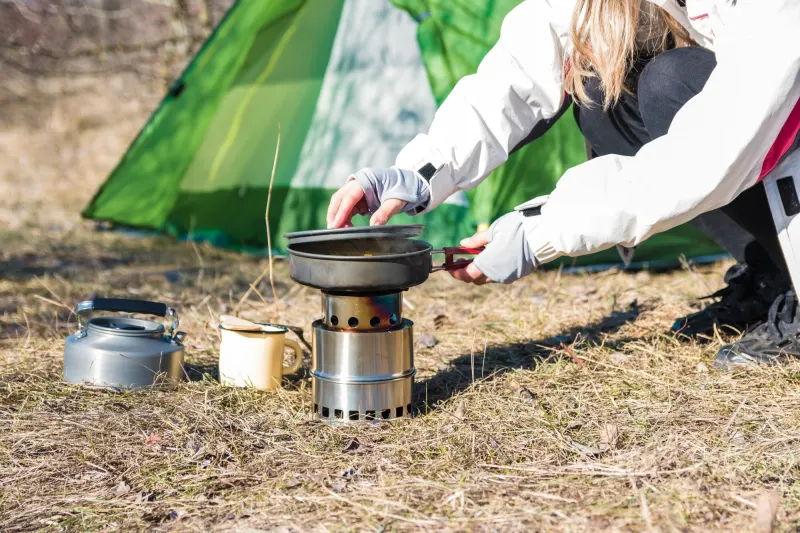
This is the most important rule. A stove, gas lantern or brazier produce carbon monoxide, a colourless, odourless gas that can kill. Health authorities advise against using them inside a tent, caravan or motorhome. A tent sealed tightly in freezing weather increases the risk. Cook outdoors or under a well-ventilated shelter. Headaches, dizziness, nausea or unusual fatigue: go into fresh air and call 15 or 112.
Small steps that make a difference
- Eat a warm, hearty meal before bed.
- Go to bed already feeling warm: a few minutes of walking before getting into the bag helps.
- Keep dry clothes reserved for nighttime, with thick socks and a beanie.
- A hot water bottle well sealed at the bottom of the bag warms your feet.
- Keep your phone and batteries in your sleeping bag: the cold drains them quickly.
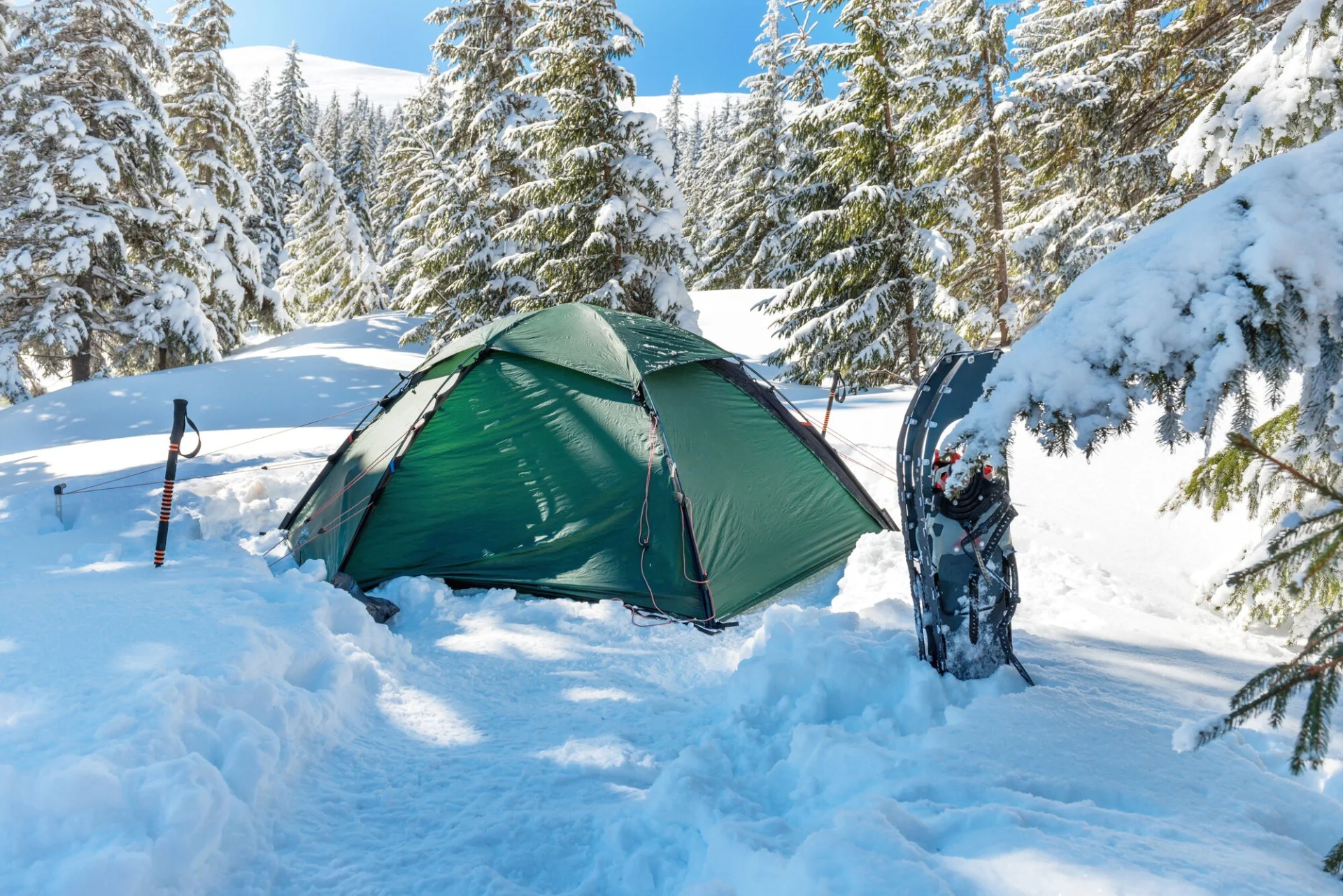
- Set up the tent sheltered from the wind and, on snow, pack down the surface before installing it.
Where to camp in winter?
Many campsites close between autumn and spring, but some stay open, especially in the mountains. In Hautes-Alpes, Camping Queyras Caravaneige in Abriès is open year-round by reservation, at the foot of the slopes. Domaine des Écrins in Châteauroux-les-Alpes shows opening from 1 January to 31 December. In Ancelle, Camping Caravaneige Les Taillas is located at 1,350 m altitude, on the edge of Parc national des Écrins. Other addresses can be found on the Hautes-Alpes campsites page.
In Jura, Camping Municipal Le Champ de Mars in Saint-Laurent-en-Grandvaux welcomes tents, caravans and motorhomes all year round except October to mid-December, with cross-country skiing and snowshoeing trails nearby. In Doubs, Camping Le Miroir in Hôpitaux-Neufs, at 1,000 m altitude near Métabief, welcomes visitors in summer and winter alike.
Opening dates change from year to year: call the campsite before you leave to find out if tent pitches are accessible and if the facilities are heated. To find other addresses near you, use the campsite map or the complete list.